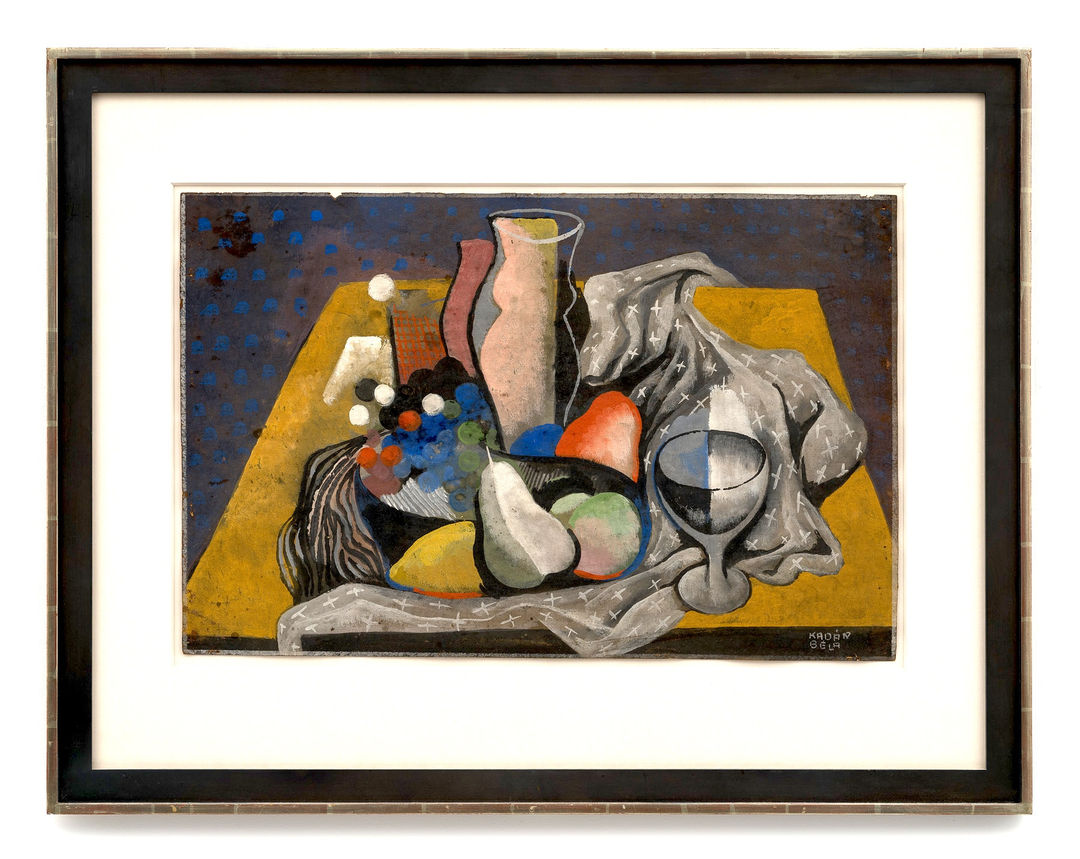
Béla Kádár (1877–1956) was a prominent Hungarian painter whose work bridged folk traditions, modernist movements, and spiritual symbolism, earning him a unique place in early 20th-century art. Born in Budapest, Kádár came from a working-class background and received his artistic training at the Budapest School of Design. His style evolved through exposure to various avant-garde movements during travels across Europe, including Cubism, Futurism, and Expressionism.
Kádár’s work is characterized by its synthesis of Hungarian folk art, mythology, and modernist aesthetics. Drawing inspiration from the rich traditions of his homeland, he combined vibrant colors, bold geometric shapes, and symbolic imagery to create evocative, dreamlike compositions. His paintings often featured allegorical scenes, fantastical landscapes, and archetypal figures, reflecting a deep interest in spirituality and the subconscious.
A significant moment in Kádár’s career came in the 1920s when he exhibited at Herwarth Walden’s renowned Der Sturm gallery in Berlin, a hub for avant-garde art. This exposure brought him international recognition and aligned him with the Expressionist movement. Notable works such as The Rider and The Tree of Life demonstrate his ability to weave narrative, abstraction, and folklore into a cohesive visual language.
Kádár exhibited widely in Europe and the United States, gaining admiration for his innovative integration of modernism and tradition. While less celebrated than some of his contemporaries, his work has been increasingly recognized for its originality and cultural significance. Kádár’s art remains a vital link between Hungarian heritage and the broader currents of early modernist experimentation, contributing to the evolution of 20th-century art.