
Marie Cuttoli (1879-1973) was a trailblazing French entrepreneur and patron whose bold fusion of avant-garde art and traditional craftsmanship transformed the decorative arts in the 20th century. Often overshadowed by the male artists she championed, Cuttoli bridged modernism and textile traditions, commissioning masterpieces from icons like Pablo Picasso, Joan Miró, Georges Braque, and Fernand Léger to breathe new life into fading industries.
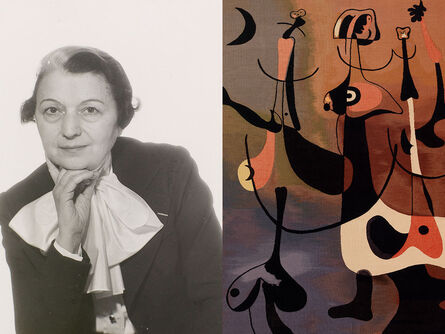
![Marie Cuttoli : [photographie]](https://bibliotheques-specialisees.paris.fr/in/rest/Thumb/image?id=p%3A%3Ausmarcdef_0001613084&author=Bonney%2C++Th%C3%A9r%C3%A8se+%281894-1978%29&title=Marie+Cuttoli+%3A+%5Bphotographie%5D&year=1926&publisher=%5BCa+1926%5D&TypeOfDocument=PhysicalDocument_DEF&mat=Photograph&ct=true&size=512)
Born Myriam Bordes in Tulle, France-a region steeped in textile heritage-Cuttoli moved to Paris as a teenager. An independent spirit, she rejected conventional paths, briefly marrying before divorcing and wedding Algerian-born politician Paul Cuttoli in 1912. This union took her to Algeria, where she established workshops teaching local women carpet weaving, blending European designs with North African techniques. Her rugs gained acclaim at the 1925 International Exposition of Modern Industrial and Decorative Arts in Paris.
Capitalizing on this success, Cuttoli launched Maison Myrbor in Paris, a boutique and gallery blending fashion, interiors, and art. Myrbor (a portmanteau of "Myriam" and "Bordes") sold embroidered dresses, appliqué garments, and rugs designed by artists like Natalia Goncharova, displayed alongside paintings to elevate textiles as fine art.
By the late 1920s, facing economic shifts, Cuttoli pivoted to tapestry. She revived the historic Aubusson workshops-near her birthplace and struggling post-World War I-by commissioning modern artists to create "cartoons" (full-scale designs) for weaving. Starting with Braque, Léger, Miró, and Picasso in 1927, she expanded to Raoul Dufy, Le Corbusier, Henri Matisse, and Georges Rouault. These tapestries translated paintings into wool and silk, creating vibrant, large-scale works that adorned homes and institutions.
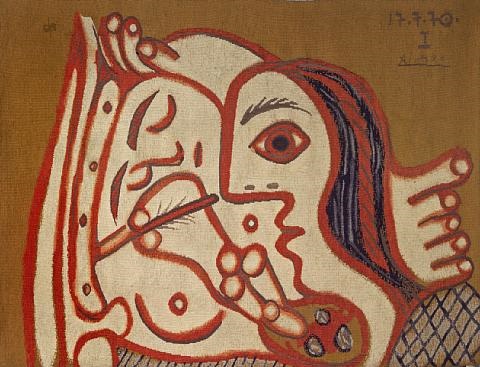
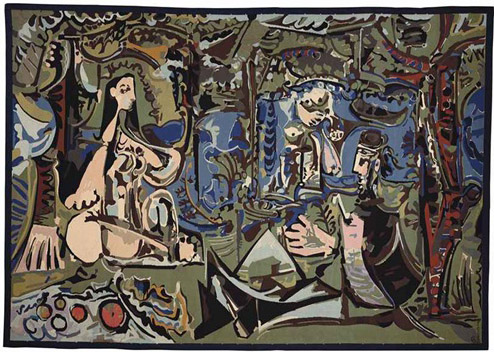
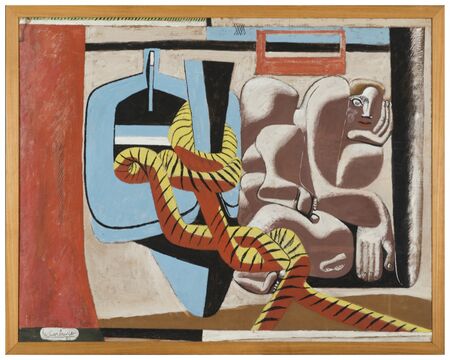

Her collaborations were groundbreaking: Picasso's designs became woven masterpieces, while Miró's rhythmic abstractions and Le Corbusier's bold forms adapted seamlessly to thread. Exhibitions toured the U.S. in the 1930s-40s, supported by collector Albert Barnes, introducing modernist tapestries to new audiences.
Cuttoli's legacy endures in museums worldwide, from the Centre Pompidou to the Barnes Foundation, which celebrated her in a 2020 exhibition. A shrewd collector herself, she donated Cubist works with partner Henri Laugier. In an era dominated by male narratives, Marie Cuttoli wove together art, commerce, and craft-proving that true innovation often threads through the hands of visionary women.

